×
Mera peak 2026

Mera Peak Trekking-17 Day/s

Mera Peak Trekking-17 Day/s

Destination
Nepal
Duration
17 Days/ 16Nights
Trip Difficulty
Peak climbing - Strenuous
Activities
Trekking | Climbing
Accomodation
Hotel | guest house
Meals
Breakfast | Lunch | Dinner
Max. Elevation
6,476 m
Group Size
1-10
Vehicle
Domestic flight | Fourwheel Jeep | Bus,car

Trip Introduction

Deemed as the highest trekking peak in Nepal, Mera Peak Trekking (6461m) is located to the south of the Mt. Everest (8848m) and sports enthralling climb to the top. It is one of the most appealing trekking peaks in Nepal as it includes traversal through picturesque villages, Buddhist monasteries, and forested trail in the Sagarmatha National Park. The difficulty is forgotten in the awe of the spectacular views of the mighty Himalayas, including the Everest (8,848m), Cho Oyu (8,188m), Lhotse (8,414m), Makalu (8,463m), and Kanchenjunga (8,586m) atop the peak.

The 17-days Mera Peak Climbing initiates as we move from Kathmandu to Lukla on a 35-minutes scenic flight to the Lukla airport, famous for being one of the most dangerous airports in the world. The Peak Climbing journey officially kicks off at Lukla and after days of trekking reaches the destination of the trip. A short trek will take you Paiya which will help you to adjust to the environment. Enjoying the beautiful views, we descend through the pine forest to cross Hinku River and finally reach Ramailo Danda. The trek goes to the north leaving the forest behind and heads along the lush pasture lands. After a pleasant walk reaching to a wide open gorge, the walk continues to a small bridge to reach Thangnak. From Khare, we make a tough strenuous climb without any technical struggle reach to the top summit of Mera peak. The raptures of joy and pride are let loose and immediately calmed by the views of the stupendous Himalayan range in the Everest region. Some of the peaks that can be seen from the top of the Mera Peak are Cho Oyu (8,188m), Lhotse (8,516m), Nuptse (7861m), and Ama Dablam (6856m) among others. After the ascent, we return back to Khare along the slippery trails. Our trip ends at Lukla as we fly back to Kathmandu.

A remarkable journey like the Mera Peak Climbing requires company and guidance of similar caliber, we, at Corporate Adventure Treks, aim to do the same. We provide English-speaking guides with origins from the Everest region and all the necessary requirements for the journey.

Overview of Itinerary

Activity Distance (km) Duration (hours) Altitude (m)
Arrive in Kathmandu 3.5 km 30 minutes 1350 m
Fly From Kathmandu to Lukla |Ramechhap to Lukla & Trek to Paiya 9.5 km 30 Minutes | 5 Hrs 2730 m
Trek from Paiya to Pangoma 11 km 5-6 hours 2846 m
Pangoma to Ramailo Danda 10 km 5-6 Hours 3276 m
Ramailo Danda to Chhatra Khola | Jungle camp 12 km 6-7 hours 3150 m
Chhatra Khola to Kothe 13 km 7-8 hours 3691 m
Kothe to Thaknak 8.5 km 4-5 hours 4358 m
Thaknak to Khare 3.5 km 4-5 hours 5045 m
At Khare | Hiking to Mera Base Camp and return 2 km 4-5 hours 5045 m
Khare to Mera High Camp 5 km 6-7 hours 5780 m
High camp to Mera Summit and Return Khare 4 km - 11 km 10-11 hours 6461 m
Reserve day for Contingency 00 00 5780 m
Khare to Kothe 13 km 6-7 hours 3691 m
Kothe to Thulikharka 6 km 6-7 hours 4250 m
Thuli Kharka to Lukla via Zatrawa La (4600m) 15 km 8-9 hours 2800m
Lukla to Kathmandu / Lukla to Ramechhap to Kathmandu 30 Minutes 1350 m
Departure to Home

Trip Highlights

  • Enthralling flight experience at the Lukla Airport
  • Glorious views of eight-thousanders like the Mt. Everest (8848m), Kanchenjunga (8586m), Lhotse (8414m), and many more
  • Explore the rich Sherpa culture at the villages en route to the Mera peak
  • Cross Zatrwa La Pass (4610m) which offers panoramic views of the Everest Himalayas
  • Explore the rich cultural heritages in Kathmandu valley

Is This Trip Suitable For You?

  • Mera pek Trekking is a strenuous graded trek. If you are reasonably healthy, can climb stairs and you have no trouble walking for a couple of hours, then you can easily do this trek.
  • You spend 15 days on the trail. The maximum time spent walking on the trail is 10 hours and a minimum of 3 hours.
  • While trekking there will be an elevation gain of 400 to 600 meters each day. The highest point you will reach during your trek is Meara peak  at 6, 461 m.
  •  The route is gentle with some steep portions and downhill descents. You walk on an unpaved gravel path. No technical maneuvers involved, just easy walking.
  • You will stop for food and rest at local mountain lodges.

Day To Day Itinerary

  • Arrival On: kathmandu
  • Departure from: Kathmandu

Day 1

Welcome to Nepal! Namaste!! Our member will be waiting for you at the arrival section. You will later be picked and transferred to the hotel room. Enjoy the evening in the streets of Thamel and cultural programs.Overnight stay at a hotel in Kathmandu.

  • Hotel: Hotel Moonlight or Similar
  • Meal: Welcome Dinner

Day 2

We take an early morning flight to one of the most dangerous airports in the world, Lukla. After 40 minutes of daring and electrifying flight, we reach Lukla to head towards Paiya with other members. After walking for about 5 hours through different villages and forest, we get the view of Kongde Ri range before we step into Paiya passing through Surke and Pakhapani.

  • Time: 35 min flight + 5-6 hours Trekking
  • Hotel: guest house/Lodge
  • Meal: Breakfast lunch dinner
  • Duration: 6-7 hours
  • Walking Distance: 6 km

Day 3

The initial part of the hike is difficult as it goes steep uphill. Leaving the Khumbu regions, we come to cross Hinku Valley. The astonishingsights of the snowy peaks captivate us as we move towards Pangkongma. After Khare Khola, we walk for hours the track becomes steeps until Pangkongma. Upon reaching Pangkongma, we can rest and prepare for the trek on the following day. Overnight stay at Pangkongma.

  • Time: 5-6 hours trekking
  • Hotel: lodge/guesthouse
  • Meal: Breakfast lunch dinner
  • Duration: 5-6 hours trekking
  • Walking Distance: 11 km

Day 4

We start trekking through the beautiful forest of bamboo and rhododendron towards Pangkongma La which is at 3170m altitude. As we walk on the stony trail, we get the mesmerizing view of Mera peak (6461m). After enjoying the beautiful view, descend through the pine forest to cross Hinku River and finally reach Nashing Dingma. Overnight stay at Nashing Dingma.

  • Time: 4-5 hours trekking
  • Hotel: lodge/ guest house
  • Meal: Breakfast lunch dinner
  • Duration: 4-5 hours trekking

Day 5

The walk starts with a downward walk followed by a decent climb until we reach Ramailo Danda. Ramailo Dada is the point from where Mera and Salpa ranges are clearly noticeable. Walking on the rugged trails for few hours, we arrive at the premise of the Makalu Barun National Park, from where we will take on the Pasang Lhamu Trails to reach Chhetra Khola Campsite. Overnight stay at Chhetra Khola Campsite.

  • Time: 7-8 hours trekking
  • Hotel: Lodge/ guest house
  • Meal: Breakfast lunch dinner
  • Duration: 7-8 hours trekking

Day 6

On this day, we leave Chhetra Khola Campsite and head to Kothe. The path goes on the main trail to Mera Peak. The trail goes along the Majang Khola and along the Hinku Khola. The trail is easy until we reach Tashinga. Leaving Tashinga, the lush trails follow Sanu River to head to Kothe. Overnight stay at Kothe.

  • Time: 6-7 hours trekking
  • Hotel: Lodge/ guest house
  • Meal: Breakfast lunch dinner
  • Duration: 6-7 hours trekking

Day 7

The walk alongside the edges of Hinku Khola leads us to Thangnak. Walking for about 5 hours, we cross the Gordishung, famous for the antique Buddhist Monastery which is called Lungsumgba Monastery. It also has temporary summer camps for herders. We finally reach Thangnak and set the camp for the night.

  • Time: 3-4 hours trekking
  • Hotel: Tent camp
  • Meal: Breakfast lunch dinner
  • Duration: 3-4 hours trekking

Day 8

Start the morning walk with a modest day walks with a breath-taking background that surrounds this Hinku valley. The walk continues on an ascending trail over moraine blocking the Charpatti Lake, leading to a high area lined with cairns overlooking the glacial lake. The trail continues to lead us to a pasture land at Dig Kharka. From here, walking for an hour across the boulder-strewn hillside, we reach Khare.Overnight stay at Khare

  • Time: 3-4 ours trekking
  • Hotel: Lodge/guest house
  • Meal: Breakfast lunch dinner
  • Duration: 3-4 ours trekking

Day 9

Before moving further, we have a rest day for acclimatization and preparation of climbing course under the supervision of our climbing guide. We head up to the start of the Mera Glacier by ascending a steep edge that we will later follow to the Mera La pass(5410m). First, we train methods on how to use crampons, rope and ice axe etc. Thereafter, we shall take on training on peak climbing. This aids us to arrange for the summit of Mera. Overnight stay at Khare.

  • Time: 6-8 hours
  • Hotel: Lodge/guest house
  • Meal: Breakfast lunch dinner
  • Duration: 6-8 hours

Day 10

The journey leads to our destination for the climb of Mera peak at its base camp, moving further along the trail that leads you over Mera Glacier, with a mild downhill reaching at Mera Base Camp for the overnight camp with sufficient time for relaxation, short walks around, and making preparations to ascend to the Mera Peak (6461m). Overnight stay at Mera High Camp.

  • Time: 6-7 hours
  • Hotel: Tent camp
  • Meal: Breakfast lunch dinner
  • Duration: 6-7 hours

Day 11

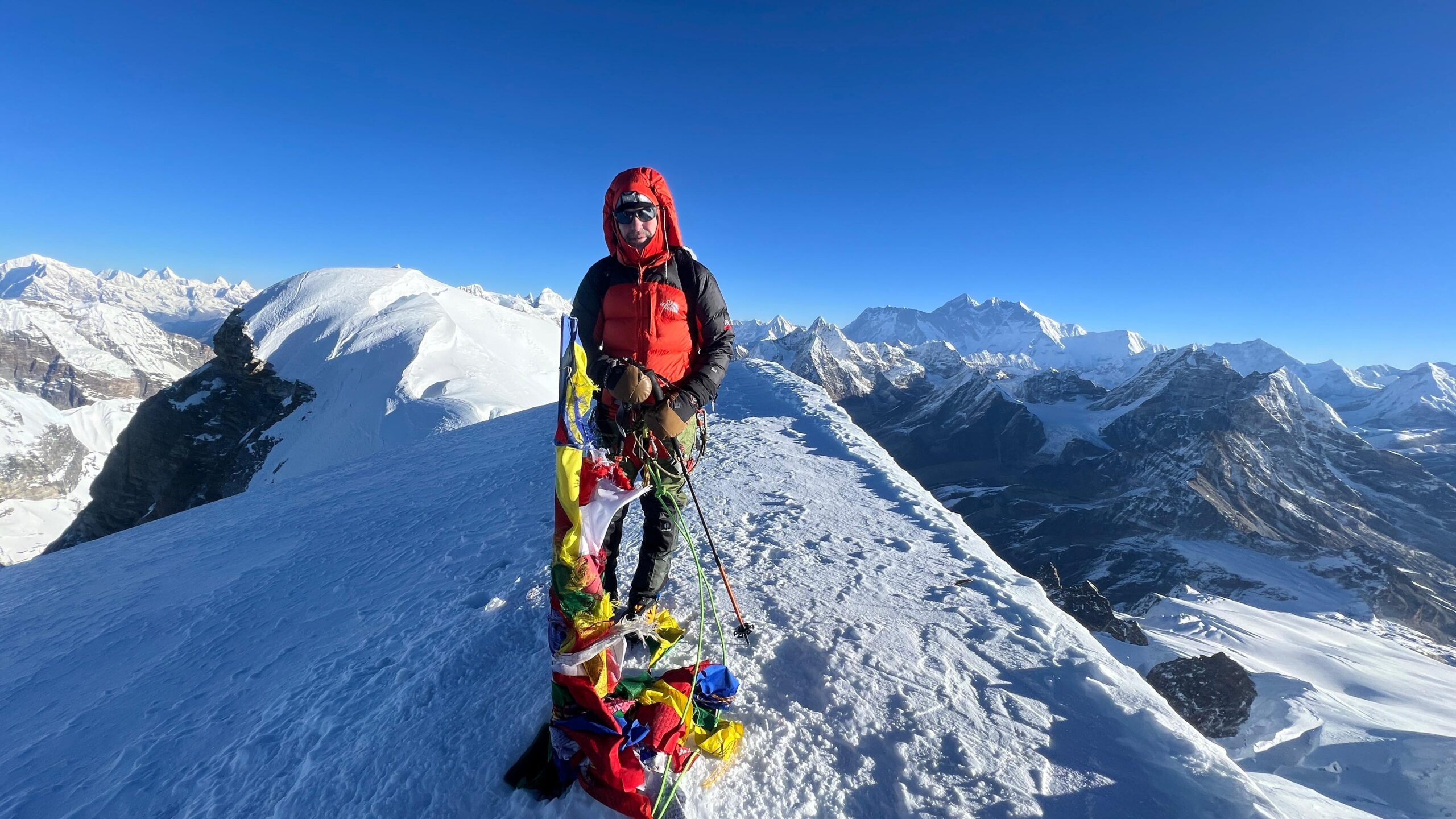
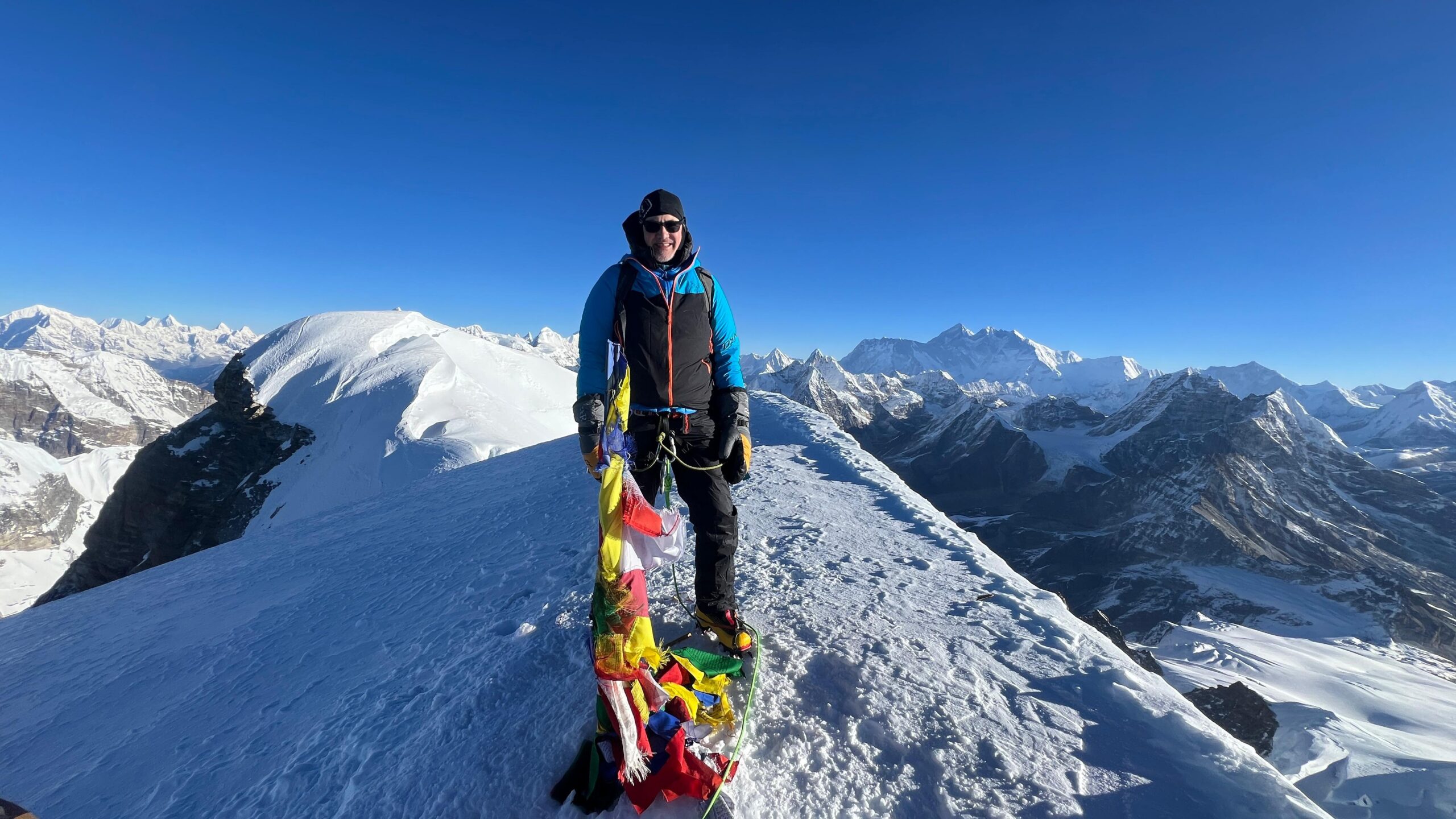
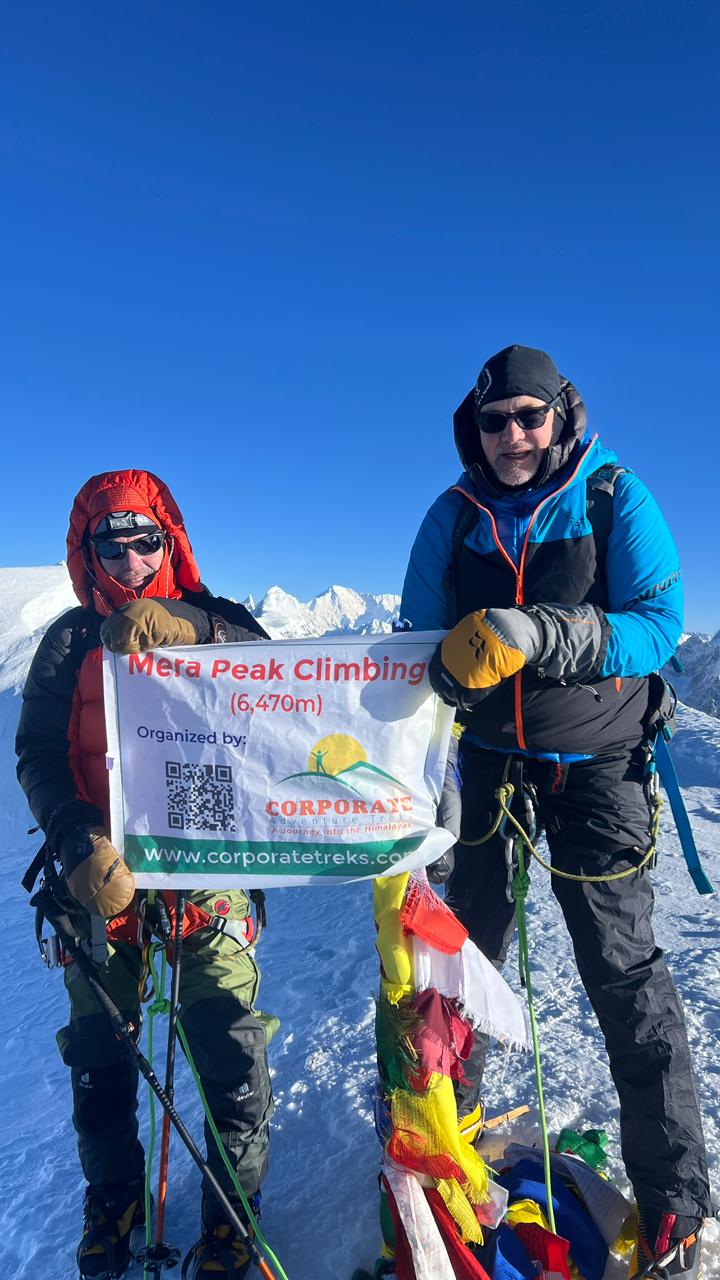
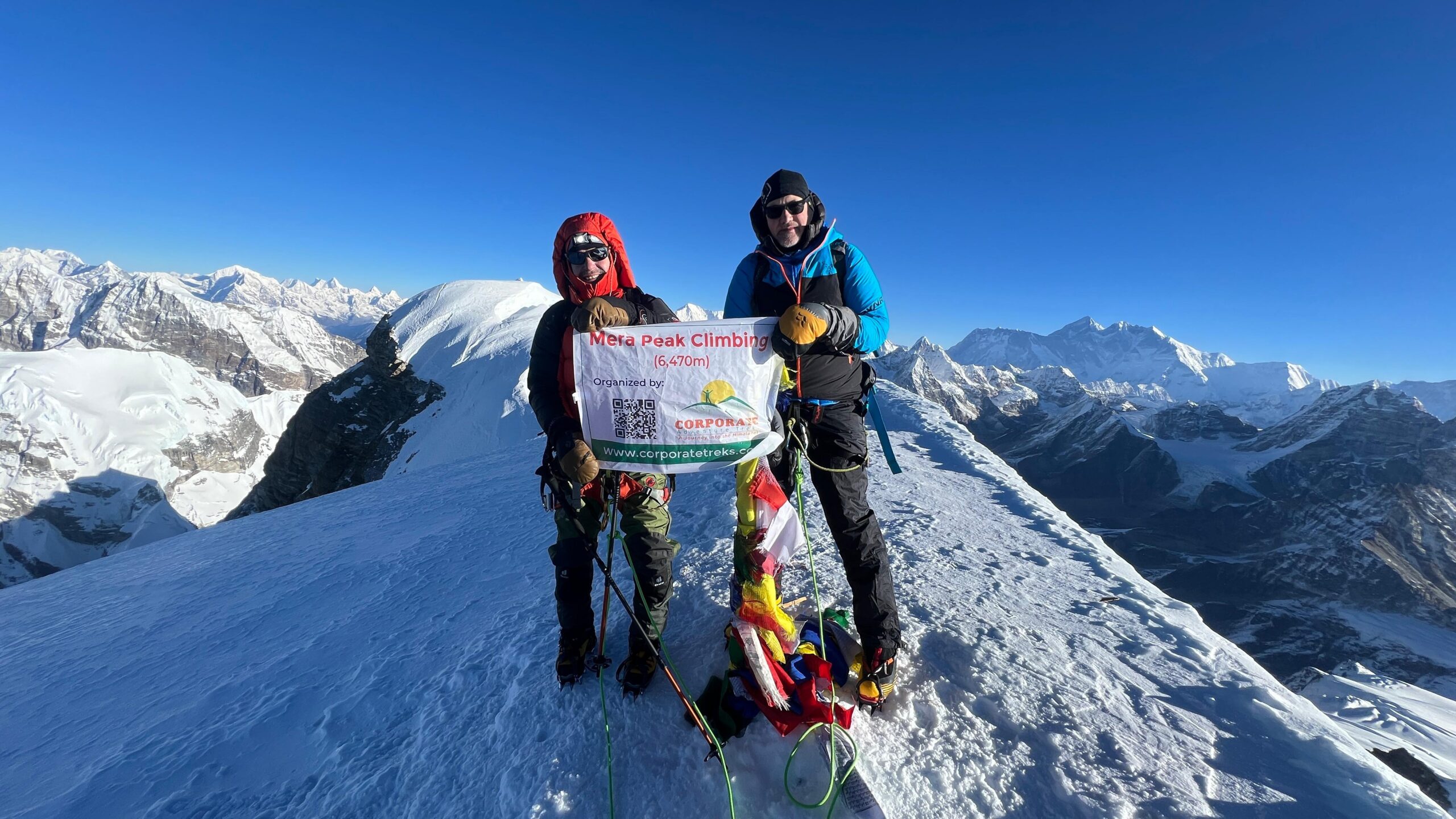
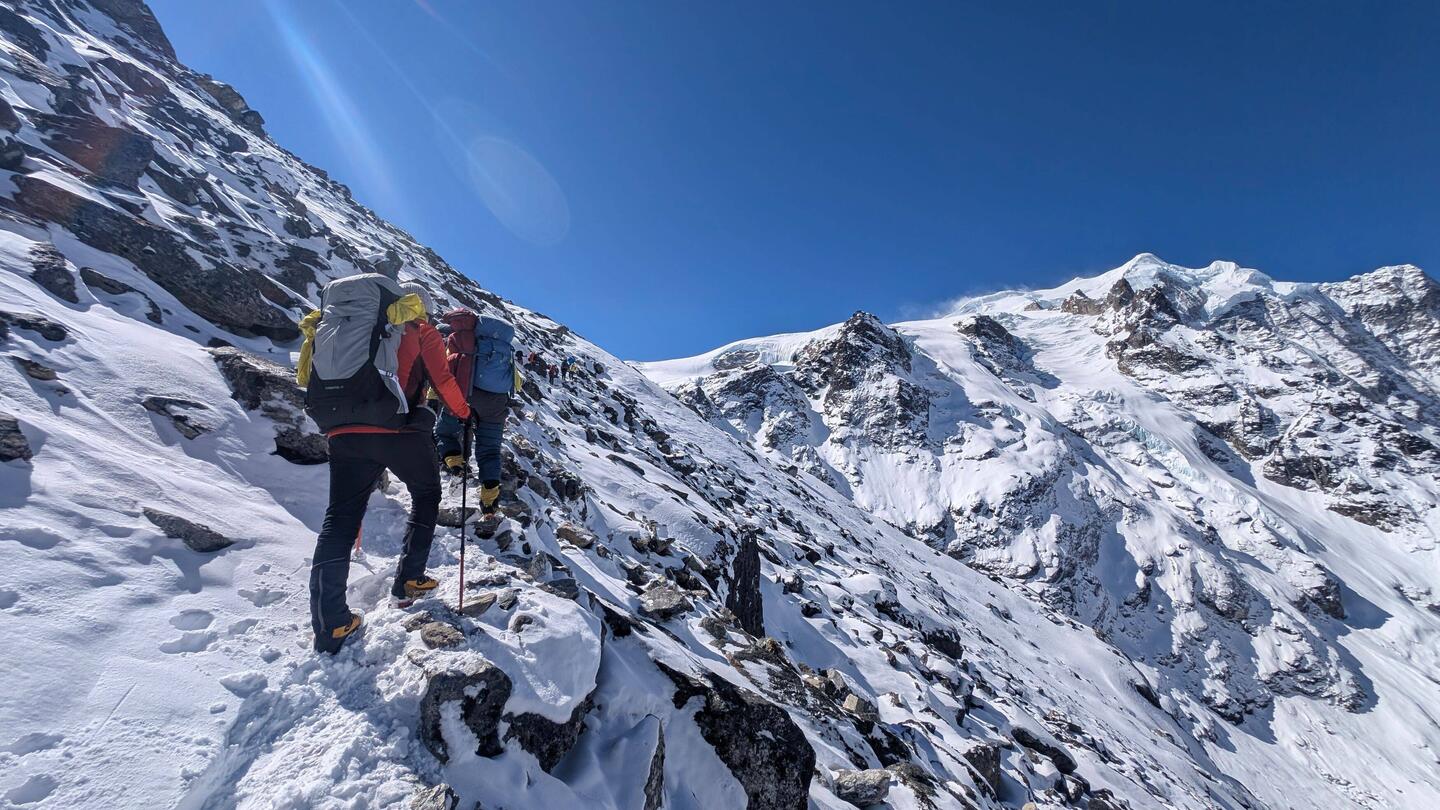
Beginning very early for the summit bid, our pathway leads with a sheer ascent. Our guides will have fixed ropes on necessary sections and after tough strenuous climbs, we reach the summit of Mera peak (6461m). A dream becomes true with an awe-inspiring success, from the top of the summit overseeing remarkable panorama that surrounds you with Cho Oyu (8,188m), Lhotse (8,414m), Makalu (8,463m), and Kanchenjunga (8,586m) to just name a few. After the ascent, we return to Khare along the slippery trails.Overnight stay at Khare.

  • Time: 8-9 hours
  • Hotel: lodge/guest house
  • Meal: Breakfast lunch dinner
  • Duration: 8-9 hours

Day 12

We have an additional day set aside for contingency. The weather in these Himalayan regions can get from bad to worse in a matter of minutes o extra care must be taken for the ascent. If everything is good,we complete the climb on the scheduled day. You can explore the places around or take on some practice that will help on the next day.Overnight stay at Khare.

  • Time: Rest
  • Hotel: lodge/ guest house
  • Meal: Breakfast lunch dinner
  • Duration: Rest

Day 13

After relishing the enthralling moment, we return to Kothe through Thangnak and then rest our aching bodies. The views are wonderful as you move to Kothe! Experience the meadows, lush valleys, and picturesque view before arriving at Kothe. The Himalayas to the north keep us chilling company as we head to Kothe on zigzag trails. Overnight stay at Kothe.

  • Time: 4-5 hours trekking
  • Hotel: Lodge / guest house
  • Meal: Breakfast lunch dinner
  • Duration: 4-5 hours trekking

Day 14

From Kothe, a morning walk takes you back to the forested area with blue Himalayan pines and rhododendrons tree lines. Crossing several nice grazing lands, we move aheadat a steady pace,and astonishing views of Mera Peak (6461m) and other mountains in the region, we arrive at Thuli Kharka. It is the last camp before reaching Lukla.Overnight stay at Thuli Kharka.

  • Time: 5-6 hours trekking
  • Hotel: Lodge/ guest house
  • Meal: Breakfast lunch dinner
  • Duration: 5-6 hours trekking

Day 15

Today, we will head to Lukla. We will retrace our steps following the Inkhu River and divert from Mosom Kharka to take a different route. We pass the Zatrwa La Pass (4610m) en route to arrive at the Lukla valley via Chutang. Since today is the last day, we can enjoy the evening with the crew members and the locals. Overnight stay at Lukla.

  • Time: 6-7 hours
  • Hotel: Lodge/ guest house
  • Meal: Breakfast lunch dinner
  • Duration: 6-7 hours

Day 16

This morning you will board the Lukla flight again and fly back to Kathmandu valley. The Everest Himalayas will be visible from the airplane for the last time for a short while. In Kathmandu, we can head to the local market and shop for gifts and souvenirs. You can enjoy the local delicacies at various restaurants and celebrate the success of the Mera Peak Climbing journey. Overnight stay at a hotel in Kathmandu.

  • Time: 35 minutes
  • Hotel: Hotel Moonlight or Similar
  • Meal: Breakfast dinner
  • Duration: 35 minutes

Day 17

Farewell! We shall drop you at the airport and we hope you had an amazing time with us. Hope to see you soon.

  • Meal: Breakfast

Included & Excluded in the Cost

Standard Package Cost $2300 Per Person
Standard Package Service Includes
  • Airport pickups and drops in a private vehicle
  • 2 Night Stay  in Kathmandu Hotel. accommodation with breakfast
  • Teahouse accommodation during the trek
  • Tented accommodation during the climb
  • All meals (breakfast, lunch and dinner) during the trek and climb except drinks
  • Welcome and farewell dinners
  • All ground transportation on a comfortable private vehicle as per the itinerary
  • Domestic flights (Kathmandu- Lukla -Kathmandu) accompanied with guide/ Ramechhap – Lula Ramechhap
  • English speaking trained and experienced trekking guide (leader), climbing guide (leader) and  group of with Staff costs including their salary, insurance, equipment, domestic airfare, food and accommodation.
  • Porter service (2 trekkers: 1 porter)
  • All necessary paper work; trekking permits and Mera Peak climbing permit
  • Good quality tents and kitchen utensils for camping
  • Group mountaineering (climbing) equipments
  • Medical kit (carried by your guide)
  • All government and local taxes
Standard Package Service Excludes
  • Nepalese visa fee
  • International airfare to and from Kathmandu
  • Excess baggage charges (if you have more than 15 kg of luggage, a cargo charge is around $1.5 per kg)
  • Extra night accommodation in Kathmandu because of early arrival, late departure, early return from mountain (due to any reason) than the scheduled itinerary
  • Altitude chamber (PAC) or oxygen
  • Lunch and evening meals in Kathmandu (and also in the case of early return from the mountain than the scheduled itinerary)
  • Travel and rescue insurance
  • Personal expenses (phone calls, internet, laundry, bar bills, battery recharge, extra porters, bottle or boiled water, shower, etc.)
  • Personal climbing equipment
  • Personal climbing guide if requested
  • Optional trips and sightseeing if extended
  • Tips for guides and porters

Accommodation

We will be accommodated 3-star Standard base hotels in Kathmandu and teahouses during the trek. All accommodations are on twin-shared basis. Single supplement will be served on request and will cost an additional USD 270. Corporate Adventure treks rooms with attached washrooms; however, teahouses in some places only have shared washing and toilet facilities. Also note that single rooms are readily available in Kathmandu and the trekking regions at lower elevation but it might be difficult to find them at higher elevations

Meals

During our Mera peak trekking, we can enjoy authentic Nepalese food as well the more common international cuisine (Tibetan, Continental, Italian, Indian, etc.). Breakfast and dinner will be served from the teahouse or from a lodge menu where we spend the night whereas lunch will be served on the way to the next destination. All meals will be provided during trekking while only breakfast will be available in Kathmandu. There will also be welcome and farewell dinners for guests.

Lukla weather and Flight

The easiest way to reach Lukla (2840m), the trailhead of your Everest Base Camp Trek is via a flight. One of the highest and most extreme airports in the world, flying to Tenzing-Hillary Airport in Lukla has its own challenges. The chief among them is the weather.

The airport is built on a narrow plateau, over a steep cliff. Navigating the plane along the short and narrow runway is difficult when strong winds whip across the mountains. Surrounded by some of the highest peaks in the world, the weather here is unpredictable and changes frequently. It would be clear and sunny one minute and the next moment the clouds will appear and everything will turn hazy. Flights operate only when the weather is stable and visibility clear.

The chances of your Lukla flight getting canceled cannot be ruled out. If this happens your EBC Trek may get extended by a day or two. So come prepared and keep buffer days so that you may not miss your international flight.

If there is a long delay due to bad weather, we will try to secure a space for you on a helicopter flight. The cost for the heli flight [USD 500 one way per person] is not included in the trip price and should be borne by you.

Due to congestion at the Kathmandu airport during high season (Spring- March, April, autumn – October, November), flights to and from Lukla now operates from Manthali Airport in Ramechhap. The airport lies 132km (4hrs 30mins drive) from Kathmandu.

However, airline companies operate their first and last flights directly from Kathmandu and Lukla (KTM-LUKLA-KTM). If you book your trip early, we can try to secure a place for you on the direct flight to or from Lukla. It will be easier and more comfortable to fly directly from Kathmandu to Lukla and vice versa, instead of making that additional journey to Ramechhap.

Helicopter Flights to Everest Region will operate from Tribhuvan International Airport, Kathmandu.

Altitude Sickness & Acclimatization

Remember you will be trekking to the world’s highest trekking destination, Mera Peak trekking  which lies well above 6000 meters beyond the sea level. Here there is less oxygen in the atmosphere which will make breathing a bit difficult.

To let your body get used to the thin air, you need to walk slowly, steadily, and keep your body hydrated. If you try to hasten and walk fast to reach your destination in less time, chances are you may suffer from AMS or Acute Mountain Sickness.

AMS symptoms like dizziness, headache, nausea, shortness of breath, fatigue, etc., are seen at elevations above 2000 meters. Usually, these symptoms occur once you reach Railodanda or beyond Ramilo danda.

Taking Diamox and a good night’s rest may work for mild cases. Drinking plenty of fluids (water, tea, soup, etc.) and keeping your body hydrated will also help to keep the sickness at bay. One should take the necessary precautions to ensure that the condition does not worsen. But if the symptoms worsen, one may have to return to a lower elevation and get medical help.

There are clinics at Lukla, Namche, and Khare which offer basic care for minor ailments. In the worst-case scenario, an air evacuation will be arranged, where the patient will be flown to Kathmandu to receive medical aid. AMS, if untreated or ignored can take your life.

On a high altitude trek like the trek to Mera, acclimatization is very important. Your body needs time to get used to thin air which can be done by resting at a lower altitude before reaching a higher level of elevation.

Our experts have included two days in the itinerary for acclimatization. During your trek, you will be spending extra days at Khara (5045m)  to acclimatize successfully before trekking further.

Physical Condition & Experiences for Mera Peak Trekking

Mera peak Trekking Does not demand any kinds of previous climbing experiences. But previous experiences of rock climbing and high altitude trekking is a bonus. This will simplify your climb.

Pre-ice climbing training is also essential. You must learn to use the climbing equipment such as ropes, ice pick, harness, and crampons.

Prepare your body for the walk over rugged hills, steep stones, and tough mountain walks. We advise you regular jogging or walking (10-12 km) per day for 2-3 months before your trip starts.

Plus, we organize pre-climbing sessions before the actual ascent to the summit. There you will get enough training on using ropes, ice axe, crampons, and learn the skill of snow climbings.

For a successful climb, your stamina, willpower, physical fitness, and adaptation characteristics play a vital role. You must walk for 5-6 hours while preparing for the trip. On the summit day of the Mera peak means a walk of 10-12 hours. Do not feel tired, keep energizing yourself. And the climb ahead is easy and exciting.

If you have pre-existing serious respiratory and chronical illness, it is better that you keep aside the idea of Lobuche peak climb. Anyone must consult their personal medical adviser before the climb.

Best Time for Mera Peak Climbing

Everything has its own time and time is the most important part of life. The same is here in Mera Peak Climbing, this peak expedition has its own best times. You cannot get ready for the climb anytime you like. There are two favorable times in a year for climbing the Mera; March to May (spring) and September to November (autumn). These suggested seasons provide the perfect conditions to do a trek and climb. Both of the seasons are completely rain-free and possess stable weather and warm temperatures. During autumn and spring, there are lower chances of the climb postponing.

You get to enjoy the whole of the expedition thoroughly if it is done in either spring or autumn. Skies are mostly clear and on the bright days, you can watch every step cautiously. There is one another perk; you will enjoy the broad panorama of Everest Region Mountains. You can encapture several high peaks in one glance as there will be no clouds hindering the view. Lobuche Peak climb is mostly a hassle-free experience if it is done in the autumn and spring.

Weather conditions during Mera Peak

In the Everest region, the weather during spring and autumn means the most stable weather. Spring is the time when the forests cover in an aroma of Rhododendron blossoms. Autumn is the seasons of festivals in Nepal and has perfect weather for the climb.

Rainy season indicates wild forest bushes, slippery trails, and more insects and bugs including leeches. Also, heavy rainfalls may block your scenic views. They can interrupt your climb by bringing more snow during the summit climb.

Winter is very cold. The cold nights and early mornings are very hard to cope with. You will need extra clothes and backpacks to keep you warm. Winter brings thick snow piles on the Lobuche peak. More the snow piles and snowfalls, the more risk is the climb.

Temperatures during Mera Peak

Early mornings and late nights are never too warm in the Himalayas. You will need a warm gear for this time while traveling at any time of the year.

In autumn the average temperature at Lobuche remains around – 5-degree Celsius. While in spring it is around – 2-degree Celsius. In winter it is around -9-degree Celsius wheres in summer it is around 5-degree Celsius.

Temperatures at the lower altitudes are a bit warmer. The more you ascend towards higher altitudes, you’ll feel gradually descending temperature.

Climbing Gear

Ascender

Ascender also called Jumar is a tool primarily used for ascending on a rope. It is made of metals, and provide sturdy support for an upward ascent. It is comfortable to use with gloves or mittens for a firm grip.

Alpine Climbing Harness

Alpine climbing harness or simply harness is a lightweight, adjustable and comfortable wearable gear. It comes with a waist belt and leg loop to secure lock around your waist and thigh with a rope or anchor point.

Crampons

Crampons are pointy boot-exterior typically used for precise movements on steep surfaces, ice fields, snow slopes, and ice-covered rocks. Crampons are key climbing gear for peak climbing. It is highly recommended to use 12 point crampons with anti-balling plates and horizontal frames.

Carabiners

A carabiner (karabiner) is yet another must-have gear for peak climbing- minimum 2 locking carabiners are obligatory. Carabiner consists of a metal loop used in safety-critical systems. It is conveniently used in all rope-intensive activities.

Descenders

Descender (Figure 8) is an aluminium 8-shaped tool used during descent- effectively helping to dissipate the heat caused by the friction. Descender is used with harness and carabiners for smooth descent on a rope.

Ice Axe

Ice Axe is indispensable when it comes to peak climbing- used for ascending as well as descending. It is made of stainless steel or aluminium, primarily used to cut and penetrate the ice surface or deep snow (can be used as a walking stick considering the assistance of shaft and spike.) Another remarkable use of Ice Axe is “Self-arrest.”

Ice Hammer

Ice Hammer resembles Ice Axe at a glance and can be used as an alternative to adze of an ice axe. It is an optional tool in the gear list for mountaineering or climbing. Ice Hammer is predominantly used for hammering the hard ice.

Ice Screw

An Ice screw is a tubular screw (10 -23cm length) used during ice climbing or crevasse rescue. It is one of the important climbing arsenal used for anchor and running belays.

Helmet

The helmet is an imperative gear in the checklist of climbing gear- for the protection of head (obviously) and successful climbing. The importance of wearing a helmet while climbing cannot be overlooked, considering the consequences of not wearing it.

Mountaineering Boots

Sturdy and quality boots are must if you are thinking of any mountaineering and climbing adventure. Mountaineering Boots play a vital role in peak climbing; the importance of boots is self-evident considering injuries, frostbite and smooth movements and shifts on the snowfield and ice field.

Rope

No Rope, No Hope- without a rope, no ascending and no descending. There are two types of rope: Static and Dynamic rope. Static ropes are used for abseiling and dynamic for belaying. The major difference between static and dynamic rope is dynamic ropes are elastic while static ropes are stiff.

Tape Sling

A Tape Sling is a sewn loop of webbing used as anchors to climb a rope. It is made of nylon or Dyneema. It can be used in conjunction with other equipment for reduction of rope drag.


Clothing

Head

Sun Hat: a lightweight hat (with visor) for shading the head

Head Lamp: outdoor headlamp (water-resistant preferred) for hand-free lighting

Glacier Sunglasses:  high-quality sunglasses for protection against reflected UVA and UVB radiation

Bandana or Head Scarf:  Bandana or head scarf keeps hair and face protected from dust and direct sunlight, rain, chilly wind

Ski Goggle: High-quality goggle for protection of eyes from sun and wind at higher altitude.

Hand Gear

Liner Gloves: Lightweight synthetic gloves for hand protection

Wind stopper Fleece Gloves: Mid-weight insulated gloves for hand protection against wind.

Expedition Mittens: expedition-rated mittens for the warmness of hand

Upper Body

Fleece Jacket with Wind stopper: warm fleece jacket for protection against the wind at higher altitude

Waterproof shell jacket: high-quality outdoor jacket (waterproof)

Down Jacket: high-quality and medium-weight down fill jacket

Short -sleeve shirt: half-sleeve innerwear with vapor-wicking capabilities

Lower Body

Light-weight pants (two pairs recommended)

Waterproof shell pants (two pairs recommended)

Fleece or woolen trousers  (two pairs recommended)

Hiking shorts and trousers (one pair recommended)

Feet

Lightweight inner socks (3 pairs recommended)

Wool socks (3 pairs recommended)

Cotton socks (1 pair recommended)

Gaiters


Personal stuff

Sleeping bag: 0-degrees Fahrenheit rated

Inflatable sleeping pad: full-length inflatable sleeping pad recommended

Water bottle: one-liter capacity bottle

Small Travel Bag: simple and lightweight bag

Expedition Duffel Bag

Small padlocks

Pee Bottle

Pee funnel for women

Trekking Poles

Swiss army knife

Toiletry bag


Medical

Personal First Aid Kit

Water purification tablets

Anti-mosquito cream

Anti-altitude sickness pills: Diamox or Acetazolamide

Earplugs

Anti-diarrhea pills

Blister repair kit

Antibiotics for chest infection

Sun protection cream


Toiletries

Towel

Toothbrush and toothpaste

Soap

Deodorants

Anti-bacterial Hand wash

Hand Wipes

Body Moisturizer

Tissue Paper

Nail Clipper

Travel Luxuries

Books

Journal

Camera

Compass / GPS

Travel Games (Chess, playing cards)

Bath suit

Solar Charger

Entry Permits & Requirements

The permits you need for the Mera Peak Trekking are –

  1. Sagarmatha National Park Entry Permit and k humbu Rural Municipality Entrance Permit. Unlike other treks in the Nepal Himalaya, you won’t be needing a TIMS (Tourist Information Management System) card.
  2. Climbing Permits fee : spring USD 350 Per Person , Autumn USd 250 Per person
  3. Sagarmatha National Park Entry Permit can be obtained from the Nepal Tourism Board’s Office in Kathmandu or at the park’s entrance gate in Lukla by paying NRS 3000. For citizens of SAARC countries, the fee is NRS 1500. You need to fill out the permit form and show your passport or a copy of your passport. This will be including on our package.
  4. To get the Khumbu Pasang Lhamu Rural Municipality Entrance Permit, you need to be in Lukla. You have to pay NRS 3000 for the permit at the rural municipality counter which lies at the edge of the village.

You won’t have to worry about queuing up to get the permits as the company or our guides will arrange all the permits for you.

Travel Insurance

For Mera peak Trekking | Climbing , you need a good travel insurance policy that offers you coverage for all activities and altitudes included in your itinerary. The highest altitude you reach is 6, 500 meters and your travel insurance should offer you suitable coverage up to this elevation.

Though we take your safety as our number one priority, we cannot rule out mishaps and emergencies that may occur at this altitude. There is less oxygen in the environment and trekkers usually suffer from Acute Mountain Sickness, which could prove to be fatal if not treated on time. Walking on a treacherous mountain environment also exposes you to physical injuries. Therefore make sure that your insurance covers the cost of all injuries and emergencies that you can possibly face during this trekking adventure. Your insurance policy should especially cover the cost of helicopter evacuation and hospitalization in case of an accident or medical emergency as these happen to be quite expensive. Check for vaccination requirements as some travel insurance policies makes it mandatory to immunize yourself before you leave your country.

Before you decide on a policy, be mindful and don’t forget to read the fine print. It would be advantageous for you also to choose a company that offers insurance cover on both domestic as well as international flight cancellations and lost or stolen baggage.

Trip Safety

We ensure the safety of our clients by following all safety protocols during the trip. The Mera Peak Trekking/ climbing Trek itinerary has been designed by travel experts and veteran guides who have guided several groups to Mera peak Trekking  innumerable times.

To prevent AMS, the required number of rest days has been added to the itinerary. Our guides always carry a first-aid kit and pulse oximeter (to measure the oxygen level in your blood) with them. The guides assigned to you have more than 10 years’ experience and know what steps to take during an emergency. They are well-trained in wilderness first aid and crisis management.

If a client shows symptoms of AMS and needs to descend to a lower elevation, an assistant guide will escort him/her and will follow the safety protocol. He will closely monitor the client’s condition and will take the required steps needed for the well-being of the client.

If he/she feels alright after a night’s rest, the guide will escort the client back to join the group. But if the condition worsens, the client will be escorted down to Lukla or get airlifted to Kathmandu for expert medical aid.

Mera peak trekking/ climbing  takes you to the highest and demanded trekking trail in the world. Having an experienced local guide accompanying you will enrich your trip in so many ways. Trekking with a person who has in-depth knowledge of the mountain will also keep you safe and secure.

When you book an Mera peak Trek with us, we pair you up with one of our local guides. All our guides have an experience of more than 10 years and have a vast knowledge of the area you are visiting. They have completed the trekking guide, Climbing course and have the required government license to work as a mountain guide and climbing guide . They can communicate in English and have received training on wilderness first aid and crisis management.

The trek will be led by a chief guide or trek leader and climbing guide. For every 8 trekkers, there will be an assistant guide assisting them personally. One porter will carry the luggage of 2 clients. Make sure that your luggage does not exceed 12/13 kg, as the porter can only carry a weight of 25/30 kg.

During the Mera peak climbing we will provide every two clinets one Mountain climbing guide .

We believe in the ethical treatment of our staff. All our Guides and Porters are provided with weather-appropriate gear and clothing to battle the harsh weather in the mountains. Before the start of a trek, we ensure that our mountain guides are fully insured. They are given fair wages and treated with respect.

We seriously follow the guidelines set by IPPG (International Porter Protection Group) and offer assistance to porters to develop other skills. A portion from the booking fee goes to fund the education of our field staffs’ kids.

Internet Connectivity on Everest | Mera peak

Despite being the world’s highest trekking trail, internet connection (though erratic and irregular at some places) is available in the Everest Region.

You can connect with your loved ones while trekking, post updates, and upload pictures on social media. Wi-fi is available at all teahouses up to Khare,  While it is free at some cafes in Lukla, most teahouses will charge you extra for using their Wi-Fi hotspot.

It will be cheaper and easier to get an Ncell (a private telecom company) sim card in Kathmandu and purchase internet data that could last you for your entire trip. The company offers 3G connectivity up to Kothe.

Everest Link, another local internet provider also offers paid internet access on the trail. You can purchase the username and password at any of the teahouses or shops along the trail.

Note: company will be provide limited data every lodge. If you need more date you can purchase direct.

Drinking Water

It is important to keep your body hydrated on the trail as dehydration also causes AMS. One should drink at least 3-4 liters of fluids daily.

We dissuade you from buying bottled water as it adds up to the thrashing problem in the mountains. Moreover like everything else, bottled water is also expensive in the mountains.

We highly recommend you to carry a reusable water bottle with you, one that can hold hot water. You can use one with a steri pen or an inbuilt filtration system like LifeStraw. You can also use water purification tablets to treat the water. While the water in the mountains tends to be pure and without impurities, it’s better not to take chances and filter or treat the water before drinking.

Using chlorine or iodine tablets to treat the water may alter its taste. You can add flavored electrolyte powder (which readily available at pharmacies in Kathmandu) to mask the bitter chemical taste. Adding electrolyte to your drinking water may also be beneficial as the minerals (sodium, potassium, magnesium, etc.) you lose while walking gets replenished.

Teahouses offer boiled drinking water at an additional cost. It can cost anywhere between 1 USD to 4 USD. Up to Namche, you may have to pay around 1 USD per liter or pot (every teahouse use a different sized pot). The price increases gradually as you climb higher. You pay the highest for boiled water at Khare, ie, 4USD. While cold water is provided free of charge, it is not advisable to drink untreated tap water.

FAQ

Mera Peak is very high, it is a straightforward climb involving glacier travel, and only a basic level of mountaineering skill is required. You will use crampons and ice axe, but there is plenty of time at the base of the mountain to learn these skills.

However, because of the altitude, the trek is still very difficult and requires a high level of fitness. You must also ensure you walk slowly, hydrate well, eat as much as you can and give yourself the best chance of arriving for summit night in good physical.

Our itinerary takes 19 days in total. It is possible to attempt this climb in fewer days than our itinerary suggests, and if you are very fit, have experience of trekking at altitude, and want to do a private trip, we are happy to arrange this. Generally though, shorter trips save days in two ways.

First, from Lukla they head straight over Zatwa La: this saves two days, but immediately takes you up to 4500m and there is a very high likelihood of climbers suffering severe altitude sickness. This is a very bad way to start your preparation for the climb.

The second way to save time is to cut out acclimatization days. Again, while this saves days, it also significantly reduces the chances of summiting successfully.

The total trekking distance is 78 miles or 125 kilometers.

The Mera Peak tour takes in everything. You begin by trekking through lush valleys, before heading higher up into farmland and rhododendron forests. From there, you’ll come across beautiful lakes and rivers, before finding yourself at the base of Mera. The summit is unforgettable as you get a magnificent view that includes Everest and Lhotse!

Mera is classified as a trekking peak in Nepal, since you will be using crampons and be on a rope, most insurance policies categorize this as mountaineering. Add in the fact that it is over 6500m, and you need to be very careful about checking your insurance policy.

Also bear in mind that unlike the treks up the main Khumbu Valley, the Mera region is relatively remote, and if you have a problem you will need a helicopter evacuation. Check insurance company in your country or let me know we will suggest insurance company.

Mera Peak sits in the Mahalangur section of the Himalaya, to the East of the main Everest massif.

Mera Peak actually has three summits: Mera North, 6,476 metres; Mera Central, 6,461 metres; and Mera South, 6,065 metres (19,898 ft). We take all our clients to the highest, Mera North.